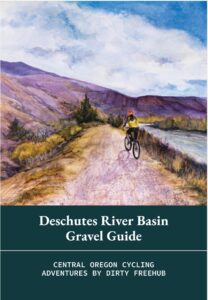
In this episode of the DF Connection podcast, Jennifer Ware-Kempcke discusses her artistic journey and her collaboration with Dirty Freehub to create the cover art for the Deschutes River Basin gravel cycling guidebook.
 As a dedicated watercolorist and teacher, Jennifer explains how her work is deeply inspired by the natural landscapes and shifting light of Central Oregon. She details her preference for versatile techniques, ranging from photorealism to abstract styles, while emphasizing her constant drive to experiment with new mediums like pastels and oils.
The conversation explores the technical challenges of commissioned work and the history of plein air painting, which involves capturing scenes directly outdoors.
Jennifer also highlights her commitment to the local art community by teaching classes and exhibiting her pieces in various regional galleries. Ultimately, the source illustrates the powerful connection between outdoor recreation, environmental storytelling, and visual art.
This podcast is brought to you in part by Visit Central Oregon and in part by kind donations from our cycling community. You can find all of our podcasts on your favorite podcast platform under DF Connection.
Transcript
0:20 Dirty Freehub
Hi, I’m Kevin English with Dirty Freebub. Today we’re with Jennifer Ware-Kempcke and we’re going to talk about the Deschutes River Basin Gravel Guidebook. Specifically, we’re going to talk about the cover art of the guidebook and some of the art inside the guidebook.
Jennifer, welcome to the podcast.
0:39 Jennifer
Thanks for having me.
0:40 Dirty Freehub
So let’s talk about your art. What inspires you?
0:45 Jennifer
I’d have to say that everyday inspires me when I look out the window. We live out in Powell Butte and it’s just beautiful every single day.
0:57 Dirty Freehub
So I think what you’re saying is you looking at landscapes, you connecting with nature is what your inspiration is.
Do I have that right or wrong it?
1:08 Jennifer
Could be that nature’s inspire me. Sometimes it’s just light.
1:13 Dirty Freehub
Let’s talk about the medium you paint in watercolor.
1:16 Jennifer
I do paint in watercolor and I teach.
1:18 Dirty Freehub
OK, when you paint in watercolor, are you going after landscapes or are you including people within your art? What do you like to do?
1:28 Jennifer
In watercolor, a lot of times because I teach, I’m also motivated by what students want to learn. So I’ve begun to do portraits and I do still life at times, but watercolor in nature and the landscape is my favorite.
1:49 Dirty Freehub
OK.
And I remember when we were doing photography of you for some cover photos, you showed me a book that had a number of different styles of watercolor in it. I’m not an artist and I’m finally starting to connect to art a little bit, but what I noticed is in that book there was many different styles of watercolor. Can you tell me more about that book and what you were using it for and what it showed?
2:18 Jennifer
Frequently I like to study different artists because they teach you so much about the medium. Watercolor is very different from any other art medium because it’s all technique driven, so you have to learn lots of techniques, and that’s what the book was about. So I might be using salt in watercolor, I might be using a granulation fluid. I might be just seeing how the colors are running together. And that’s what you saw in the book.
I was studying the artist Jane Betteridge, who’s an English artist, and she leans more towards the abstract.
3:00 Dirty Freehub
Can watercolor be done in a style that’s almost photographic also or not?
3:06 Jennifer
Watercolor can go the whole gamut, so it can be very abstract or it can look photorealistic. So it depends on the techniques that you use and how detailed you want your work to be.
3:21 Dirty Freehub
Right now you’re studying abstract. What drew you to studying abstract?
3:28 Jennifer
I’ve always liked a looser form, so we think of the different techniques like wet and wet, where I throw a water down and then I throw paint into it, and then I see what happens with the paint and we move from there. And that’s kind of what draws me is that it helps me to build imagination. I’m not simply copying a reference or copying a photo. It becomes alive and it’s real.
3:55 Dirty Freehub
And are you painting for yourself or are you painting for commissions or what is your kind of your driving force for why you paint?
4:06 Jennifer
You know, honestly, I paint every day. It’s not something that everyone does. But if I don’t paint, I get kind of that itchy feeling that you probably get if you don’t exercise. And so I have to be in the studio or I paint mentally. When we’re riding in the car, I’m thinking about, oh, look at how the light is coming through those trees, look at how the light is bouncing off that surface. And I try and create that mental image so that I can draw on it later when I’m painting.
So I’m kind of always painting.
4:42 Dirty Freehub
And you said a couple interesting things.
When I’ve talked to other artists, light seems to come up as a theme a lot in terms of artists looking at the way light reflects or comes through trees. So light is important to you. Are there stylistic colors that you gravitate towards?
5:04 Jennifer
I’ve been learning some new things from a Jean Harris book, and Jean Haynes says that you should always be looking for new colors, that there’s always something new and exciting that you can find out there, that you should never become reliant on your same familiar colors. So I’m trying to think about that when I’m working and trying to incorporate new ideas of that color.
5:31 Dirty Freehub
OK.
And do you have a style that you would say, is your current style or is your style always evolving and changing?
5:45 Jennifer
Well, because I work in different mediums, that does happen because when I paint in pastel, it’s very stiff.
It’s more like drawing. When I paint in acrylic, it dries very quickly, so I have to move very quickly. So a lot of times the medium is also driving what you’re doing in art and how you’re looking at something. And so when I look at subjects, I say, oh, that would be great in a pastel painting, or, oh, I want to do that in watercolor.
6:15 Dirty Freehub
So with watercolor, so you mentioned a couple couple different types of mediums there, acrylic, pastel, watercolor, how much your work is done in watercolor?
6:25 Jennifer
I go in spurts, you know, where I’m very excited about watercolor for a few months and I don’t paint pastel at all. Or I’ll become very excited about something I learned in acrylic and I’ll paint acrylic for a while. But I always come back to watercolor. Watercolor is my home base.
It’s that part where if I don’t paint in it, I feel kind of lost. So a lot of times, even the greatest artist, they did studies always in watercolor. So that’s one thing that people don’t know about. John Singer Sargent is that his favorite thing to work in was watercolor, but oil paid the bills.
7:10 Dirty Freehub
That’s interesting.
Along that theme, you said you also teach teach painting.
7:16 Jennifer
I do.
7:17 Dirty Freehub
What medium is your favorite to teach with?
7:20 Jennifer
I only teach in watercolor.
7:22 Dirty Freehub
OK, OK.
7:23 Jennifer
Yeah, I, I don’t feel as confident in the other mediums, but I know a lot that watercolor and so I always feel very confident about teaching people what I know.
7:34 Dirty Freehub
OK, And let’s back up a little bit before we get on.
On the podcast here, you talked about teaching in terms of you were a teacher at one point.
How long have you been doing art?
7:44 Jennifer
I’d say I’ve been doing art for about 40 years, OK. I mean, I started out as a child. I think everybody starts out as a child and then we get kind of pushed away from art for various reasons. You know, in my family, being an artist is not considered a job. And so, you know, I was pushed towards teaching and I’ve enjoyed every minute of teaching.
8:12 Dirty Freehub
OK.
And did you teach art or did you teach something different?
8:16 Jennifer
I taught kindergarten, I taught special needs students, and I’ve taught adults.
8:22 Dirty Freehub
OK.
Can you give us a little bit more about yourself besides just your art? Something you’d else you’d be open and willing to share.
8:32 Jennifer
I’ve been married for quite a while to my husband Kurt and recently Kurt’s become an artist which we never expected because he always said I can’t draw a stick figure. But he became fascinated by welding, so at times we collaborate on some of his welding projects and I’ll draw things out for him because he’s he’s not a person who draws things. Or I’ll help him with composition because that’s not something he has studied.
9:06 Dirty Freehub
I would think that’s pretty special to have that kind of bond at this point in your life.
9:12 Jennifer
It was something that he had not really considered doing, but he found a passion for it after studying at DIY Cave. He took a class because he always wanted to learn how to Weld and he took a class at DIY Cave and after that he was just on fire. So now we go out to Swift and McCormick and we get lots of rusty stuff and he has me come out and help him because I can kind of see how you put things together.
9:42 Dirty Freehub
Let’s talk about this project a little bit.
So you did the cover for the Deschutes River Basin gravel guide. Can you share the story of how we met and how you got involved in this project?
9:55 Jennifer
One of the things that I enjoy doing is plant air painting, and that’s where you go when you paint in the environment, you’re limited to about two hours because the light will stay consistent for that long. And we were very busy at the pond, at Mirror Pond that day. And I was there with my friends that I paint with, and I really wasn’t paying much attention. I was trying to catch the light coming off the pond and bouncing off. And so I heard something going on in the background. And you had stopped to talk to my friends who were also painting. And you asked them, do you know a good watercolor artist? And they turned around and they all painted at me and said, it’s her.
So you approached me about the project and I pretty much said no, because commissions can be interesting or they can just be really difficult. So I really, I wasn’t thinking I would do anything like that. But you brought me some of your books and I looked through and I read through your books and I was very impressed with what you do. And I felt you’re telling the story of the environment, you’re telling the story of the people, and you’re telling the story of what you do. And it shows your passion for what you do.
And that’s what attracted me to this project, because commissions are not really that fun.
11:26 Dirty Freehub
OK.
And you did the cover piece for the …
11:29 Jennifer
Book I did.
11:30 Dirty Freehub
Which is a Commission piece.
Can you tell us a little bit about that process?
Because as we went through this process, I learned actually a lot of things about how a Commission works and which I did never knew before because there’s a lot of steps involved here. Can you tell us about that?
11:47 Jennifer
First of all, I needed to know what the timeline was. That was very important to me because I had other stuff coming up and I do show in several places and I need art for those places. And if I carve out a lot of time to work on one project, I don’t have time for the other galleries. So I wanted to make sure that I had time to complete the project, that it wouldn’t interfere with anything else. And we had a vacation coming up, things like that. So I was very concerned about that.
I was very concerned about, you know, what was the expectation? Are you going to like what I do? Are you going to ask me to change a lot of things? Because, you know, starters are a little picky about that. So I wanted to be sure I nailed that down.
So I got excited about it looking at your book, and I thought, well, I’m going to try some of the things from around Central Oregon. So I did some waterfalls and I did them in three different styles and thought, well, let’s just see how this works. So I brought them to our meeting at Larkspur and I was impressed by the things that you had to say. And I thought, you know, I, I think this is something I could be involved in. This is something I might like to really enjoy in doing.
13:05 Dirty Freehub
Where can people find your art?
13:07 Jennifer
I am showing at Dry Canyon Arts Association in Redmond and they have some of my pieces there. I show at Sagebrushers Art Society at their gallery. I currently have some pastel paintings up there and I show at Larkspur. I have some work at Layer Art Gallery here in town.
And you know, I’ve done a few other things outside of town that it’s much more difficult delivering art in other places, but those are the places I am currently.
13:42Dirty Freehub
What is next for you?
13:45 Jennifer
I’m working with oil pastels. I’ve never wanted to work with oil because it has a lot of solvents and I don’t think it’s good for the environment. I think it’s kind of dangerous to the artist as well. But I’ve gotten interested in these oil sticks because you don’t need to use any solvents. You can use natural things like walnut oil.
So I’m, I’m learning a new medium and I’ve been learning about collage that I’d never tried that before. So I took a class in that. So I can just see, you know, building up so that I can incorporate some of my mediums all together. So I’ve been incorporating these oil pastels in with the watercolor and I just am finding it really is very interesting to me.
I just like to keep exploring.
14:40 Dirty Freehub
Keep learning.
14:41 Jennifer
Keep learning, keep exploring, that’s all I want to do.
14:44 Dirty Freehub
So I’d like you to educate me a little bit. So you mentioned 2 words that I’ve heard before, but I couldn’t really define pastels and collage. What is each of those?
14:54 Jennifer
Pastels come either with an oil base, where pigments come either from a synthetic market or pigments come from nature. So some pigments come to us because they’re ground up rocks and then they’re mixed with a binder. And that’s what happens in any medium. The pigment has to be mixed with some kind of binder. And so when you’re using pastel, they’ve been mixed with a different chalky binder or an oil binder with watercolor. It’s mixed with something called gum Arabic that is a clear fluid. And so they take a powder and they mix it with this clear fluid and they make a cake.
And plenair comes to us from the Impressionist because they wanted to take their art outside into the light and they’ve created these metal tubes. Before that, artists had to go and buy their pigment and everything that they were going to do that day because it was ground at the pigmentist, the colorist. And so with these tubes, they could now take their pigments outside and paint outside. And that’s how we come to have plenair painting.
It’s how the Impressionist created all that light.
16:16 Dirty Freehub
That’s interesting, I kind of wish I could live 9 different lives and I’m going to take one of my 9 lives here and live it. If somebody wanted to become involved in art later in life, let’s say after 40 and and has an interest in this, how would they get started?
16:33 Jennifer
I always tell them that you can start on your own. YouTube is in a fabulous resource. It is like the university of our age. Or you can go take class.
I teach classes at Larkspur and I do a beginning watercolor for them and I do an intermediate watercolor and I just do it for free just to help them out because people may not know, but the Larkspur spinner has to earn some of their money. The city doesn’t just give them all the money they need for operating expenses. So if they don’t have classes and they’re not earning money, they’re coming up short with the city. So I donate my time to them.
17:21 Dirty Freehub
That’s very generous of you.
I super appreciate you being involved in this project. The more of these books we do and have artists involved, the more intrigued I am becoming with art. And I know very little about it. But each time I step into this, I’m learning more about it and it’s very fascinating to me. And now Linda, my wife and I are, are looking at different art pieces in terms of what what can we get for the house, what’s interesting, which I think is pretty cool.
And I really appreciate you taking that risk with us to do the commissioned piece. And I think it came, it came out absolutely gorgeous. I love it.
And this is probably the book that we are the most proud of in terms of how it came out. And a lot of that has to do with you.
Thank you very much.
18:08 Jennifer
And thank you for the Commission. It was great doing it with you.