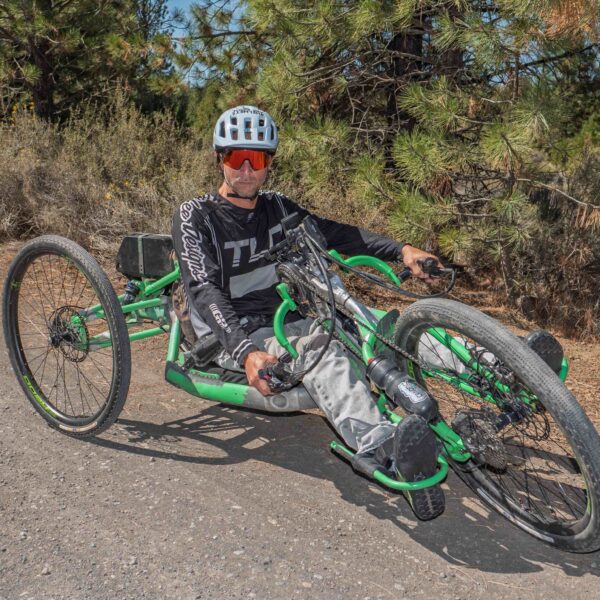
I’ve always loved being outside and pushing myself through adventure. After a mountain biking accident in 2017 in Moab, which resulted in a spinal cord injury and left me unable to walk, I had to figure out a new way to get back to the places and activities that were such an important part of my life and get back into the wild. For me, adaptive sports became that way back.
I adapted a kayak, learned to mono-ski, but with the help from Craig Hospital in Colorado, immediately found my way back onto dirt with an adaptive mountain bike. Getting back on a bike wasn’t just about riding again. It was about independence, adventure, challenge, and being able to explore wild places under my own power. Freedom.
Today, I’m still riding, still learning, and still looking for new trails and the next adventure.
About Skye
Skye Chaney is an adaptive cyclist and outdoor athlete based in Bend, Oregon. In October 2017, Skye was mountain charging the famous Porcupine Rim trail in Moab, Utah, when a crash sent him over the handlebars. He landed on his head, breaking his back and sustaining a spinal cord injury, along with seven broken ribs, a fractured sternum and fractured manubrium.
The accident changed how Skye moves through the world, but it didn’t change his desire to explore it.
Skye began finding ways back into the outdoor sports he loved. He adapted a kayak, learned mono-skiing, and returned to mountain biking aboard an adaptive mountain bike. He has since become an experienced adaptive mountain biker, participating in High Fives Foundation adaptive cycling programs and events, competing in para cycling events such as the Sea Otter Classic, riding Whistler, Jackson Hole, Whitefish and Arizona to name a few.
Closer to home, Skye is a regular on Central Oregon’s trails and has also been part of the broader conversation about making Bend and Sisters trail systems work better for adaptive riders. As well as part of Arizona’s infamous Hawes trail network.
For Skye, adaptive cycling isn’t about doing a lesser version of the sport. It’s about finding a different way to experience the same things cyclists have always loved: freedom, challenge, speed, dirt, exploration, grit in the teeth and a really good day outside. That’s exactly why we’re proud to call Skye a Dirty Freehub Gravel Champ.
Why Skye Is a Gravel Champ
Gravel Champs aren’t defined by how fast they ride or how many miles they rack up. They’re people who show what’s possible on a bike and, in doing so, encourage someone else to get out and ride.
Skye represents an important part of the cycling community: adaptive riders who are expanding our ideas about where bikes can go and who gets to experience those places.
His story is also a reminder that accessibility isn’t just about creating “easy” routes. It’s about providing good information, understanding the needs of different riders, and creating opportunities for more people to experience the freedom of riding outside.
Favorite Dirty Freehub Route
Japanese Hollow
Organizations Skye Supports / Has Been Involved With
High Fives Foundation — Supporting athletes who have experienced life-changing injuries and
helping them return to outdoor sports.
Oregon Adaptive Sports — Creating opportunities for people with disabilities to experience
outdoor recreation in Central Oregon.
Challenged Athlete Foundation — To provide opportunity, access, and belonging for
athletes with physical disabilities—because sport transforms lives.
Ability 360 — Providing exceptional adaptive sports, recreation, aquatic, and fitness programs
that promote the independence, health, and overall well being of people with disabilities and
their family members.
Teton Adaptive — The mission is to develop recreation opportunities for people with disabilities
living in and visiting the Greater Teton Area. Teton Adaptive serves individuals who have
physical, developmental or cognitive disabilities.
Kelly Brush Foundation — To inspire and empower people with spinal cord injuries to lead
active and engaged lives.
What Skye Wants Other Riders to Know
Adventure doesn’t have to look the same for everyone. Sometimes getting back outside requires a different bike, a different line, a little creativity, or help from a community that believes everyone deserves the opportunity to ride. The important part is getting out there.