
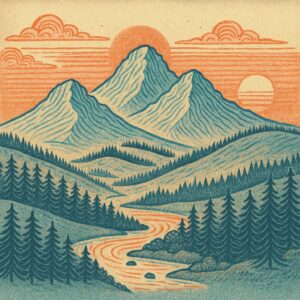
 Long before these peaks were stone and snow, they were people.
Two brothers, proud and strong.
Wy’east, the fiery one—quick to laugh, but quicker to rise in anger.
Pahto, quieter, heavier in thought, but no less fierce.
And between them lived a maiden, Loowit, graceful as moonlight on still water.
Their father was the Great Spirit, Sahale—some call him Tyhee Saghalie—a being whose breath shaped the valleys and whose footsteps carved the first rivers. He watched over his children as they grew, but even he could not keep rivalry from kindling in their hearts.
When the brothers began quarreling over land—each wanting more than the other—Sahale had them stand on a high ridge. He gave each a bow and a single arrow.
“Shoot,” he said, “and where your arrow falls, you will make your home.”
Wy’east’s arrow flew far south, bold and bright.
Pahto’s drifted north, steady and sure.
So the brothers parted, and for a time there was calm. Sahale even built a magnificent bridge between their new lands—a bridge that arced across the great river below, so both peoples could meet in peace. We now call that place the Bridge of the Gods.
But peace is fragile, especially where hearts are involved.
Both brothers soon fell in love with the maiden Loowit. She moved like wind on the water, gentle but impossible to hold. Each brother tried to win her favor, each certain he was the one she secretly loved. Yet Loowit could not choose—her heart was tangled, her feelings uncertain.
Jealousy smoldered. Pride cracked.
And the brothers went to war.
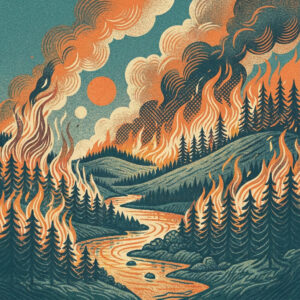 Some say that when Wy’east struck in rage, whole forests caught fire.
When Pahto answered, rocks fell like lightning.
Flames licked the sky. Villages burned. The air itself trembled under their fury.
And in the midst of it all, Loowit wept.
The battle was so fierce that the great bridge Sahale had made collapsed under the violence. Its stones fell into the river with a roar that split the land wide open. The chasm left behind—the Columbia River Gorge—is said to be the scar of that shattered bridge.
When Sahale saw the destruction his children had caused, his sorrow turned cold and absolute. He struck all three down—not out of cruelty, but out of the deepest disappointment—and transformed them into mountains so they would stand forever in the shapes their spirits had earned.
Wy’east rose as Mount Hood, tall and proud, his head lifted high as though still defiant.
Pahto became Mount Adams, his form bowed toward the earth, mourning the choices that led him here.
Loowit became Mount St. Helens, beautiful and once gracefully smoking—a reminder of love, loss, and the fire that shaped her fate.
And that is why, when you look across this land, the mountains do not just stand.
They remember.
Their silhouettes are the frozen echo of a rivalry, a heartbreak, and a judgment delivered by the Great Spirit.
In their shapes, in their scars, in their silence—you can still hear the story if you listen long enough.
Significance of the Legend
Even if the legend may not be a rigorously documented “authentic indigenous myth,” it remains important for several reasons:
- It reflects how people have long tried to understand and interpret the dramatic geography of the Cascade volcanoes — turning mountains into characters, putting emotion and morality into geology.
- It highlights the cultural importance of the landscape: these peaks are more than physical landmarks — they are part of identity, story, memory.
- It serves as a bridge between past & present — reminding us of Indigenous presence, worldview, and how those stories interact (or sometimes conflict) with modern naming and mapping.
- It inspires conservation, respect, and meaning: whether one believes it literally or metaphorically, the legend encourages viewing these mountains not simply as resources or recreation zones, but as places embedded in heritage and meaning.

 Behind every route is scouting, mapping, storytelling, and a whole lot of pedal power.